
SUSTAINABILITY

01Funasho Shoji’s Sustainability Initiatives
— For People, Communities, Environment, and the Future of Our Planet —
As an importer of fresh produce that values mutual growth and coexistence with producers and growing regions worldwide, Funasho Shoji is committed to contributing to the sustainable development of society. We also regard it as our mission to continue supporting Japan’s dining tables for generations to come.
In 2023, we established the Sustainability Promotion Department to clarify this commitment further.
Today, the impacts of global climate change are increasingly affecting the fresh produce distribution industry. Amid these challenges, building sustainable sourcing, supply, and operational systems has become one of our highest priorities.
Serving as the driving force behind our company-wide sustainability efforts, the Sustainability Promotion Department leads our initiatives toward responsible business practices and sustainable fresh produce distribution.

02Our Commitment to the SDGs
Funasho Shoji is committed to the Sustainable Development Goals (SDGs) adopted
by the international community, aiming to achieve them by 2030.

Funasho Shoji and the SDGs
Since its establishment in 1974, Funasho Shoji has imported a wide variety of fresh produce from around the world and supplied it throughout Japan.
Guided by the belief that stability in sourcing regions and improved job satisfaction for our employees are essential to sustainable growth, the Funasho Shoji Group has been implementing a range of initiatives. This page has been created to organize our past efforts and serve as a guiding framework for future social contributions.
Through these initiatives, we will address key issues and help achieve the SDGs.
| Goals | Funasho Shoji’s initiatives | |
|---|---|---|
 |
We work to end hunger, achieve food security, improve nutrition, and promote sustainable agriculture |
 |
 |
We ensure inclusive and equitable quality education and promote lifelong learning opportunities for all |
|
 |
We promote sustained, inclusive, and sustainable economic growth, full and productive employment, and decent work for all |
|
 |
We are taking urgent action to combat climate change and its impacts |
|
 |
We strengthen the means of implementation and collaborate with international partners for sustainable development |
|

03Scrum Japan Program
 https://www.scrumjapanprogram.jp/
Funasho Shoji supports rugby-based educational programs for children who will shape Japan’s future. Implemented by the Japan Rugby Football Union, this program helps students from elementary through high school develop essential skills through rugby, including teamwork, strong bonds with teammates, and the ability to stay focused and seize opportunities. With growing attention surrounding the Rugby World Cup 2023, and in alignment with our commitment to the SDG goal of “Quality Education,” we participate in this initiative as a supporting member.
04International Year of Fruits and Vegetables 2021
 https://www.maff.go.jp/j/seisan/ryutu/engei/iyfv.html
Funasho Shoji is an official supporter of the International Year of Fruits and Vegetables 2021.
The International Year of Fruits and Vegetables 2021 was designated by the United Nations as an opportunity to raise awareness of the vital role that fruits and vegetables play in our lives. It was established with the following objectives:
- 1) Raising awareness of and directing policy attention to the nutrition and health benefits of fruit and vegetable consumption;
- 2) Promoting diversified, balanced, and healthy diets and lifestyles through fruit and vegetable consumption; and
- 3) Reducing losses and waste of fruits and vegetables within food systems
In support of these objectives, Funasho Shoji will undertake the following initiatives:
- Promote the International Year of Fruits and Vegetables 2021 on our website and social media channels to raise awareness of the value of fruits and vegetables.
- Publicly express our commitment to the principles of the International Year of Fruits and Vegetables 2021, highlighting our role as a produce company to attract like-minded talent who share our vision.
We have long conducted our business in line with our management philosophy of contributing to society through the distribution of fresh produce.
Through this website, we also share information on the production, distribution, and sales of fruits and vegetables.
As an official supporter of the International Year of Fruits and Vegetables, we will further strengthen our efforts to communicate the value and appeal of fresh produce, guided by the three objectives set forth by the United Nations and the Ministry of Agriculture, Forestry and Fisheries.
05Japan Philippines Industry Council (JPIC)
Since our establishment in 1974, Funasho Shoji has grown alongside bananas from the Philippines. As our ties with Davao City on Mindanao Island, which is one of the country’s major banana-producing regions, have deepened, we have come to recognize the strong and enduring connection between the Philippines and Japan.
Before World War II, many Japanese moved to Mindanao Island from Japan. After the war, for various reasons, some were unable to return to Japan. These Japanese nationals and their descendants were compelled to live as so-called “remaining Japanese” in a society where strong anti-Japanese sentiment prevailed. In particular, second-generation Japanese descendants were forced to conceal their Japanese identity, adopt Filipino names, and struggle to survive. Due to limited access to education, many Japanese-Filipino families subsequently found themselves living in poverty.
JPIC is an organization made up of companies that employ Japanese descendants in the Philippines. It verifies the identities and nationalities of second-generation descendants, assists third- and fourth-generation descendants in obtaining long-term residency status in Japan, and supports efforts to preserve and certify their Japanese heritage and identity.
Beginning in 1995, when second-generation Japanese descendants in the Philippines were first officially recognized in Japanese family registers, many third- and fourth-generation descendants whose identities had been confirmed became eligible to come to Japan on long-term residency visas. They have since been employed as regular workers by member companies of JPIC and continue to play an important role in supporting Japan’s economy today.
Our Board Chair, Akira Sekino, served as Chairman of JPIC from 1998 to 2004. During this period, he dedicated himself to verifying identities and worked tirelessly to help Japanese descendants set foot in their ancestral homeland.
In 2000, he visited Attorney Kawai, who had a proven track record in helping Chinese war orphans obtain Japanese nationality, and repeatedly appealed to him on behalf of JPIC for assistance with the issue of Japanese descendants remaining in the Philippines. With Attorney Kawai’s cooperation, these efforts eventually led to the launch of the NPO Philippine Nikkei-jin Legal Support Center (PNLSC) in 2003.
Since the establishment of PNLSC, Funasho Shoji has worked alongside the organization to address challenges faced by Japanese descendants in the Philippines and to support their lives in Japan. As many second-generation descendants in the Philippines remain unidentified, we will continue to support related initiatives through PNLSC.
Today, Japanese descendant associations across the Philippines are working toward independent and sustainable operations. Among them, the Philippine Nikkei-jin Kai (PNJK) in Davao, which we support, celebrated its 40th anniversary in 2020.
Established to promote mutual support among Japanese descendants displaced by the war, the association has made significant progress in improving its members’ social and economic conditions and now also provides educational support for fourth- and fifth-generation descendants.
In cooperation with the directors of the Japan-Philippines Volunteer Association (JPVA), Funasho Shoji has consistently supported activities to deliver baseball equipment to youth baseball tournaments in Davao, Philippines, since 2006. These tournaments, organized with the support of the Tokyo Kichijoji Lions Club and local communities, aim to promote youth development and sports participation.
Funasho Shoji’s humanitarian support, made possible through bananas.
We will continue to support Japanese descendants in the Philippines, the home of our banana-growing partners, in the years ahead.
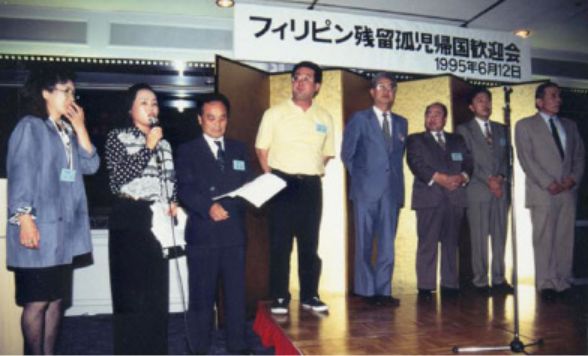 Welcome ceremony for repatriated Japanese orphans
from the Philippines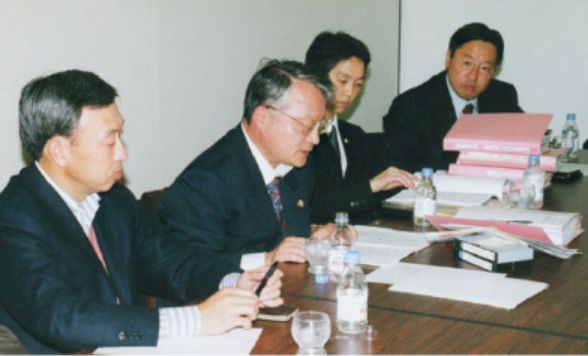 A scene from a PNLSC meeting
06Support for studying in Japan
Funasho Shoji provides study-abroad support to graduates of the Philippine Nikkei-jin Kai International School High School in Davao City, Republic of the Philippines. This school was established in 1992 by the Davao Philippine Nikkei-jin Kai, an organization formed by descendants of Japanese immigrants who settled in Davao before World War II, to address the educational needs of local youth. It is now a private institution offering education from kindergarten through high school, with approximately 1,600 students enrolled. While about 70% of the students are Filipino, many have connections to Japan through Japanese ancestry, family members married to Japanese nationals, or relatives working in Japan. In recent years, cooperation with the Japanese government has expanded, and both staff and students have gained more opportunities to participate in events organized by the Japanese Embassy and consulates.
Against this backdrop, since its establishment, the school has placed strong emphasis on learning the Japanese language and culture, with these subjects included in the core curriculum.
As a result, many students are highly motivated in their Japanese studies and aspire to pursue further education in Japan. They aspire to open new paths for their future by studying in Japan and developing advanced Japanese language skills. However, despite this ambition, financial constraints prevent many from achieving it.
Through our long-standing relationship with the Philippine Nikkei-jin Kai and related educational institutions, Funasho Shoji has recognized the presence of many highly motivated and talented Filipino students within these communities. We believe it is essential to establish and implement a study-abroad support system that enables not only Japanese descendants but also other Filipino students to pursue their dream of studying in Japan.
To this end, we engaged in detailed discussions with the school and developed a support framework to enable students to study and live in Japan. Scholarship recipients are selected by the school’s teachers, who have a deep understanding of each student’s academic abilities and character. We also provide financial assistance to cover study-abroad expenses in Japan. According to the Japan Student Services Organization, more than 70% of international students engage in part-time work, and in some cases, this negatively affects their academic performance. Under our program, we also support living expenses so that students can focus fully on their studies.
The scholarship recipients for the 2019 academic year enrolled at TCJ Japanese Language School in October 2019, where students can obtain qualifications to become certified Japanese language teachers. We will continue this program, the “Youth Brighter Future Scholarship,” and, through ongoing educational support for outstanding young people, we aim to further strengthen our relationship with the Philippines.
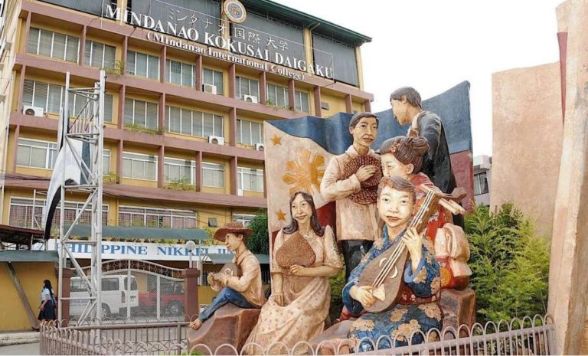 Mindanao International University School Building
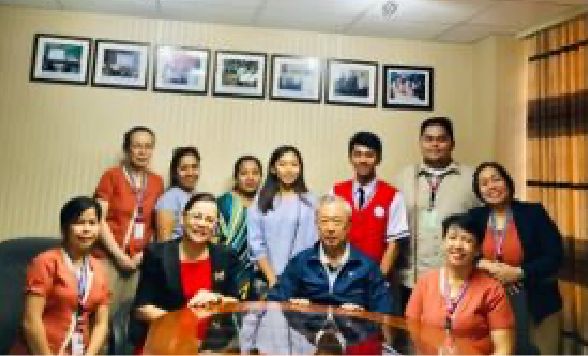 Chairman Sekino with staff of the Philippine Nikkei-jin Kai International School and scholarship students
 Scholarship students for 2019 and 2020